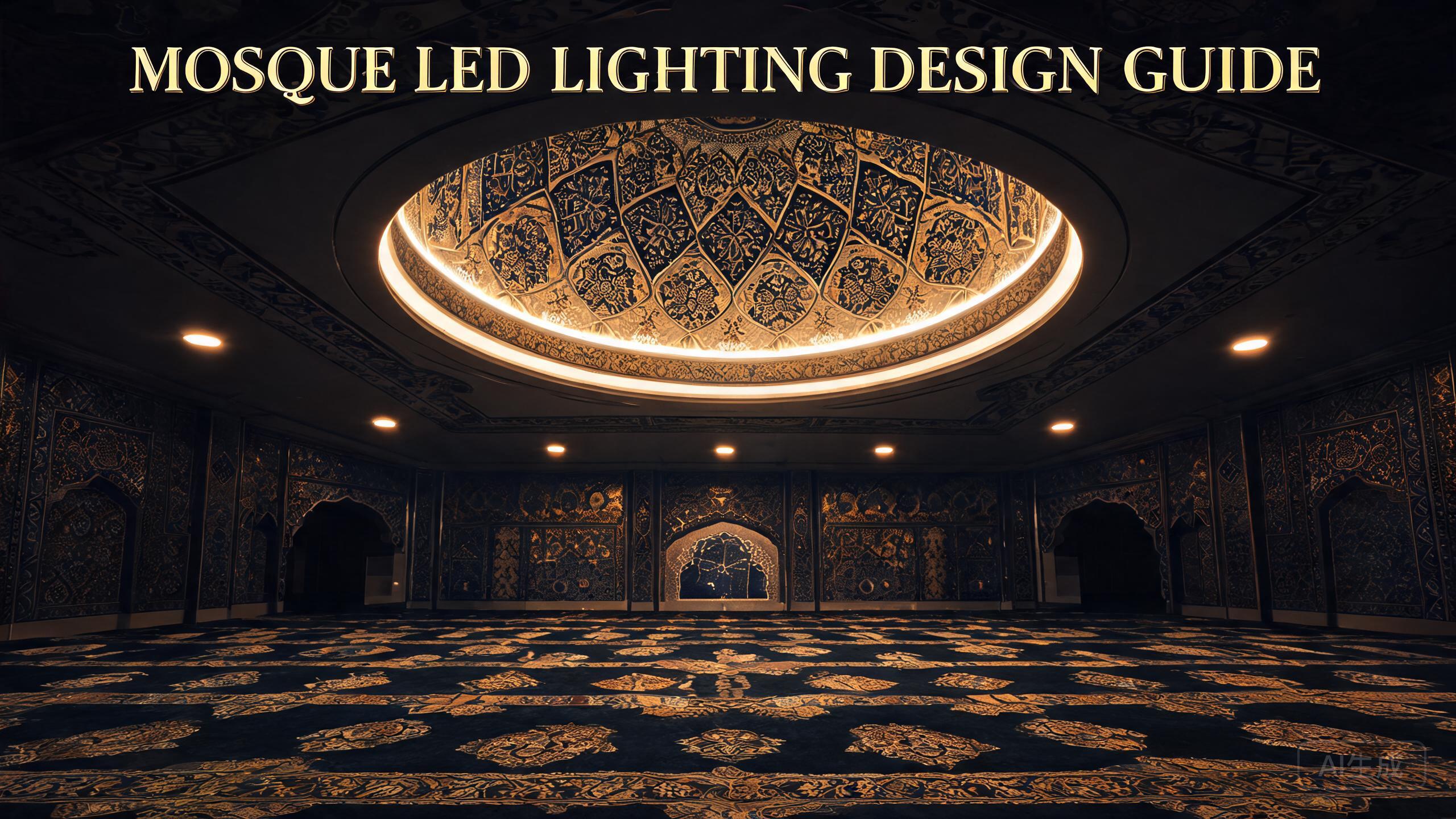
Mosque lighting is one of the most specialized applications in commercial LED illumination. It must balance technical performance (high CRI, uniform illuminance, heat resistance) with spiritual atmosphere (warm, contemplative, reverent). This guide covers the principles, product specifications, and design considerations for lighting mosques in the Middle East.
Why Mosque Lighting Is Different
A mosque is not a standard commercial building. It serves multiple functions — daily prayer, Friday congregation, Quranic study, community gatherings — each with different lighting needs. The architecture itself, with domes, arches, minarets, and ornate geometric patterns, demands lighting that enhances rather than competes with the design.
Key Differences from Standard Commercial Lighting
| Factor | Standard Commercial | Mosque |
|---|---|---|
| Purpose | Task visibility, productivity | Spiritual atmosphere + task visibility |
| Ceiling height | 2.8-3.5m | 6-15m (main prayer hall) |
| CRI requirement | Ra80+ | Ra90+ (for Quran reading, carpet color accuracy) |
| Color temperature | 4000K uniform | 2700K-3000K (warm, contemplative) |
| Dimming | Optional | Essential (adjust for prayer times, day/night) |
| Glare control | Standard | Critical (worshippers look downward in sujud) |
| IP rating | Indoor: IP20 | Wudu areas: IP65+ |
Prayer Hall Lighting Design
Illuminance Levels
The main prayer hall (musalla) requires different lighting levels for different activities:
| Activity | Recommended Illuminance | Notes |
|---|---|---|
| Daily prayer | 150-200 lux | Soft, non-distracting |
| Friday Khutbah | 300-400 lux | Clear visibility of the Imam |
| Quranic study | 400-500 lux | Task-level for reading |
| Cleaning/maintenance | 500+ lux | Full brightness via separate circuit |
Product Recommendations for Prayer Hall
Primary lighting: High-bay LED fixtures with wide beam angle (110-120°) mounted at 8-12m height. Key specs:
- Wattage: 150W-240W (depending on hall size and mounting height)
- Color temperature: 3000K (warm white, creates calm atmosphere)
- CRI: Ra90+ (accurate rendering of carpet patterns and Quran text)
- Dimming: 0-10V or DALI (for prayer time adjustment)
- Glare: UGR<19 (worshippers perform sujud — downward-facing position makes glare control critical)
Supplementary lighting: Recessed downlights along the perimeter walls and around columns for uniform fill light. Key specs:
- Wattage: 20-30W
- Beam angle: 60° (narrow enough to avoid wall washing, wide enough for floor coverage)
- Color temperature: 3000K (match primary lighting)
- CRI: Ra90+
Uniformity and Glare Control
Prayer halls require high uniformity (U0 > 0.6) to avoid bright spots and dark corners. Worshippers face the Qibla wall in parallel rows — lighting should be evenly distributed across the entire floor area, not concentrated in the center.
Glare is a unique concern in mosques because worshippers spend significant time in sujud (prostration), facing downward. Any directly visible light source at this angle becomes a source of discomfort. Solutions:
- Use fixtures with deep reflectors or honeycomb louvers
- Avoid exposed LED chips — always use diffused or recessed fixtures
- Position high-bay fixtures above the line of sight when standing
Dome Lighting
The dome (qubba) is the architectural centerpiece of most mosques. Lighting it requires a balance between highlighting the form and creating a spiritual focal point.
Interior Dome Lighting
- Cove lighting: LED strip lights (IP20, 2700K, Ra90+) concealed in a cove around the dome base, creating an upward wash that highlights the interior curve
- Pendant fixture: A central pendant chandelier (often custom-designed) provides both functional light and visual focus
- Color: Warm white (2700K-3000K) maintains the traditional golden glow
Exterior Dome Lighting
- Flood lighting: Narrow-beam LED floodlights (15-30°) ground-mounted around the dome base, washing the exterior surface
- Color: 3000K for traditional warm appearance; RGBW for special occasions (green for Mawlid, white for Ramadan)
- IP rating: IP66+ (outdoor, exposed to sand and heat)
- IK rating: IK08+ (impact resistance for ground-mounted fixtures)
Minaret Lighting
Minarets are the tallest elements of a mosque and serve as visual landmarks. Lighting them effectively requires long-throw, high-intensity fixtures.
Approach
| Lighting Method | Fixture Type | Beam Angle | Wattage |
|---|---|---|---|
| Base-up flood | LED floodlight | 15-25° (narrow) | 100-200W |
| Mid-section grazing | LED wall washer | 60° (asymmetric) | 50-100W |
| Top accent (crescent) | LED spotlight | 10° (very narrow) | 30-50W |
Key considerations:
- Heat: Minaret tops can reach 60-70°C in Saudi summer — use fixtures rated for 50°C+ ambient
- Maintenance: Minaret access is difficult — use long-life LEDs (L70 > 50,000 hours) to minimize replacement
- Glare: Avoid light spill toward neighboring residential areas — use precise beam control
Wudu (Ablution) Area Lighting
The Wudu area is where worshippers perform ritual ablution before prayer. This is a wet environment with specific lighting requirements.
Specifications
- IP rating: IP65+ (water jets from all directions)
- IK rating: IK08+ (impact resistance)
- Voltage: 24V DC or low-voltage LED strips preferred (safety in wet areas)
- Color temperature: 4000K (neutral white for accurate visibility — worshippers need to see that all body parts are clean)
- CRI: Ra80+ (sufficient for this task)
- Fixture type: Recessed downlight with diffused cover, or linear LED with IP65 housing
- Emergency lighting: Required — Wudu areas may be used during power outages
Courtyard Lighting
The mosque courtyard (sahn) is used for overflow prayer during Friday prayers, Eid, and Ramadan. Lighting must accommodate both pedestrian circulation and prayer.
Specifications
- Pole-mounted area lights: 6-8m height, 80-120W LED, IP66, IK10
- Color temperature: 3000K (consistent with prayer hall)
- Dimming: Essential — courtyard lights should dim to 30-50% during late-night hours and full brightness during prayer times
- Uniformity: U0 > 0.4 (lower than indoor, but sufficient for safety and prayer)
- Glare: Full cutoff fixtures to minimize upward light pollution (important in residential neighborhoods)
Ramadan and Special Occasion Lighting
Ramadan and the two Eids require enhanced lighting for extended night prayer (Taraweeh). Design the lighting system with this in mind:
- Prayer hall: Increase illuminance to 300-400 lux for extended night prayers
- Courtyard: Full brightness for overflow prayer
- Exterior: Decorative string lights or architectural lighting on the mosque facade
- Dimming schedule: Pre-programmed scenes for Fajr (dawn), Maghrib (sunset), and Isha (night) prayer times
Product Specifications Summary
| Application | Fixture Type | Wattage | CCT | CRI | IP | Notes |
|---|---|---|---|---|---|---|
| Prayer hall (high ceiling) | LED high bay | 150-240W | 3000K | Ra90+ | IP20 | UGR<19, dimmable |
| Prayer hall (low ceiling) | LED downlight | 20-30W | 3000K | Ra90+ | IP20 | Recessed, diffused |
| Dome interior | LED strip + pendant | Variable | 2700K | Ra90+ | IP20 | Cove-mounted |
| Dome exterior | LED floodlight | 100-200W | 3000K | Ra80+ | IP66 | Narrow beam |
| Minaret | LED floodlight | 50-200W | 3000K | Ra80+ | IP66 | 50°C+ rated |
| Wudu area | LED downlight/linear | 15-30W | 4000K | Ra80+ | IP65 | Low voltage |
| Courtyard | LED area light | 80-120W | 3000K | Ra80+ | IP66 | Full cutoff, dimmable |
Middle East Environmental Considerations
All mosque lighting in the GCC region must account for:
-
Ambient temperature 50°C+: Use fixtures with thermal management designed for desert climates. LED driver lifespan is the primary failure point — every 10°C above rated temperature halves driver life.
-
Sand and dust: IP66 minimum for all outdoor fixtures. Sand accumulation on lenses reduces light output by 15-30% — design with 20% maintenance margin.
-
UV exposure: High UV index degrades plastic lenses and gaskets. Use fixtures with borosilicate glass lenses and silicone gaskets.
-
Humidity and salt: Coastal mosques (Jeddah, Dubai, Doha) require IP66+ and marine-grade aluminum housings to resist salt corrosion.
-
Power supply stability: Voltage fluctuations are common in some areas. Use LED drivers with wide input voltage range (170-264V AC) and surge protection (4kV minimum).
DIALux Lighting Design for Mosques
Yakeen Lighting provides free DIALux lighting simulation for mosque projects. Our service includes:
- 3D model of the prayer hall with accurate ceiling heights and finishes
- Illuminance calculation on the prayer floor (horizontal and vertical)
- Uniformity analysis (U0, U1)
- Glare assessment (UGR calculation)
- Fixture schedule with quantities, wattages, and positions
- Dimming scene recommendations for different prayer times
Contact Yakeen Lighting for a free DIALux mosque lighting design, or browse our LED high bay lights and LED flood lights suitable for mosque applications.
For more lighting design guides, read our Hotel Lighting Design Guide and High Temperature LED Lighting Guide.